Axiscope
IMPROVE
your purchasing process performance by digitalizing your Procurement system
CREATE
value from collective intelligence and collaboration between buyers and prescribers
VALUE
your suppliers in a collaborative purchasing approach to encourage innovation and anticipate risks

AXISCOPE DIGITAL SOURCING & PROCUREMENT PLATFORM

PURCHASING DIGITALIZATION SOLUTION

Operate a collaborative digital Purchasing platform to encourage collective work and improve process execution
Read more

SOURCING & SUPPLIER QUALITY

Collectively drive the SEO processes, tendering, evaluation and monitoring of supplier performance and quality
Read more

ANALYZE AND PURCHASING PERFORMANCE

Prepare shared action plans and dynamics dashboards to implement an effective and efficient purchasing strategy
Read more

E-PROCUREMENT & PAPERLESS INVOICES

Organize, facilitate, streamline, and computerize supply activities, purchasing requests & invoicing upon receipt
Read more

A PLATFORM TO DIGITALIZE PURCHASING & QUALITY PROCESSES

Our platform offers ready-to-use and state-of-the-art features for PROMOTING good Purchasing practices, LEADING its communities, GROWING collective motivation and exemplary behavior. Axiscope allows you to UNLOCK the Purchasing department to increase collective intelligence and to INNOVATE with suppliers.
Multilingual and entirely configurable, Axiscope adapts to your collaborative needs while offering a unique user experience. You have complete freedom of choice in terms of implementation's pace, focusing on modules adjusting to your purchasing priorities.

PURCHASING AND QUALITY FEATURES AT THE SERVICE OF THE USER

Axiscope allows to involve your prescribers in the purchasing process to CREATE LINKS between collaborators and suppliers, IDENTIFY earning opportunities, MONITOR supplier performance, FOLLOW UP on purchasing action plans and COLLABORATE more easily both internally and with your suppliers on high-stakes projects.
The modules are integrated in our collaborative Axiscope platform. They were designed to specifically respond to the needs of customers who require increased collaboration. Our modules are continually evolving taking into account your challenges and concerns.

COLLABORATIVE API AND SECURED SAAS ARCHITECTURE

Axiscope features are accessible for external authorized applications in “API mode” to INTEGRATE to an existing information system, SOCIALIZE existing applications or EXPAND the model and offer additional user services. Our APIs are built according to CUTTING EDGE TECHNOLOGY and documented for each type of use.
Built on open technology, Axiscope adapts and fits to your environment to leverage collaborative strength to increase the value of and optimize your information system. We provide support to your teams as they adopt our architecture and give them increased autonomy.

Axiscope Collaborative Purchasing Solution

ciscope
A unique purchasing platform integrated in SaaS mode

The Axiscope Digital Sourcing & Procurement platform is based on web 2.0 technologies to offer powerful and ergonomic solutions that are quick to implement, easy to use and responsive to company needs.

Axiscope DSP decompartmentalizes the Purchasing department by increasing its collaboration with prescribers and suppliers, wherever they may be and regardless of the equipment they use: PC, MAC, tablet or smartphone, resulting in a platform that is simple to use and boasts outstanding traceability.
Ready to use Web 2.0 purchasing applications

The AXISCOPE DIGITAL SOURCING & PROCUREMENT PLATFORM allows the digitization of purchasing processes to computerize sourcing to receipt while favoring collaboration between buyers, prescribers and suppliers.

Axiscope DSP is based on innovative business modules covering the complete scope of purchasing processes: from SIM (Supplier Information Management) to SRM (Supplier Relationship Management), and from Supplier Performance and Purchasing to Quality Management (APQP, Audit) and e-Procurement.

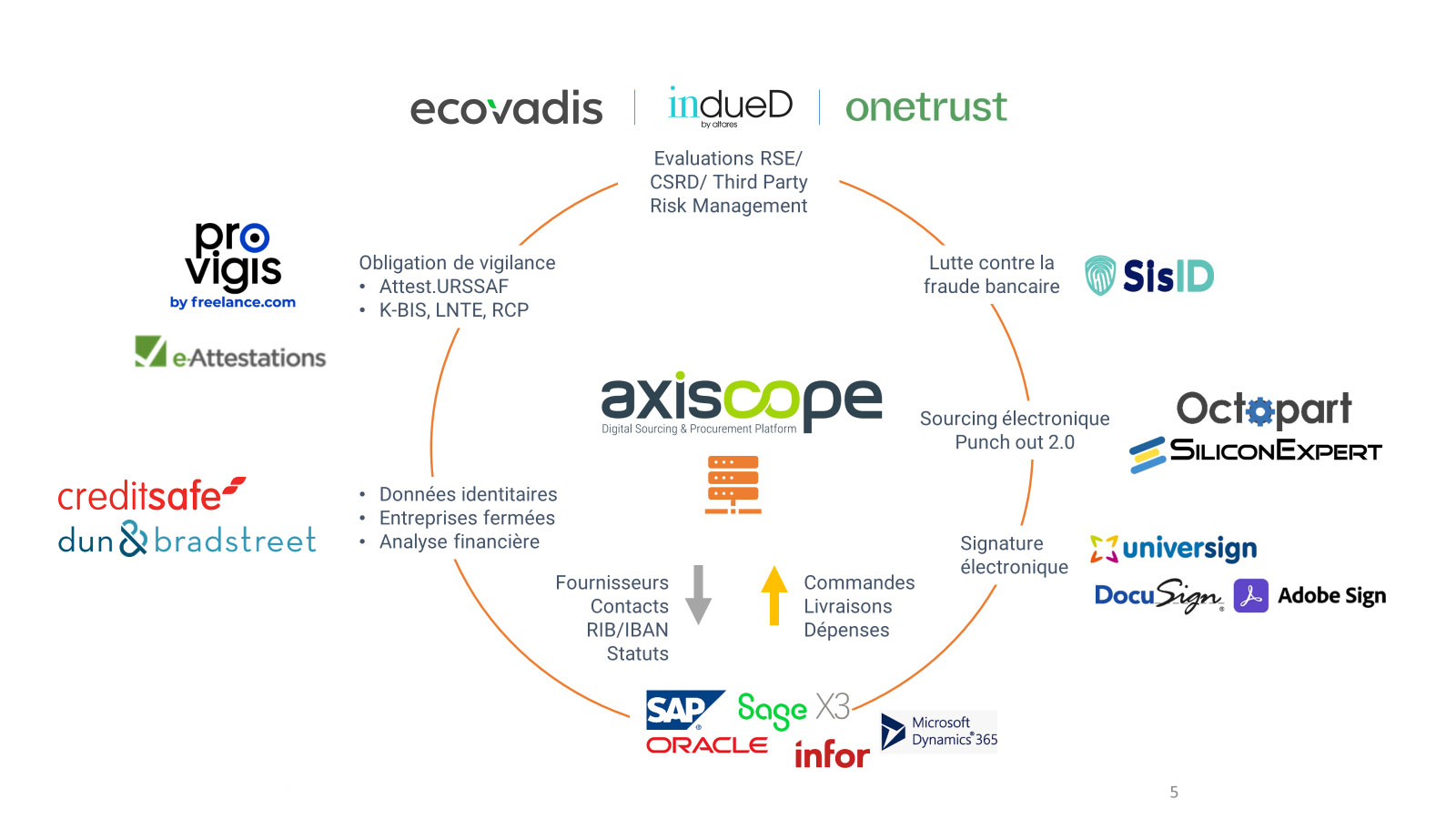
Intégration native des connecteurs et interfaces S.I

Intégration native des connecteurs et interfaces S.I

FAQ

SRM (Supplier Relationship Management) software is a tool designed to optimize supplier relationship management processes within companies. The primary objective of this type of software is to centralize and simplify collaboration with suppliers, enabling better communication, effective contract management, and in-depth analysis of the performance and risks associated with each supplier. When used correctly, SRM software significantly improves the efficiency of purchasing and supply chain operations, while reducing costs and strengthening regulatory compliance.

SRM software works by centralizing all supplier-related data in a single platform. This centralization facilitates daily access to and management of information. Here are the main components and features that enable an SRM to operate effectively:


  1. Centralized database: All supplier information, including contract details, past performance, and communications, is stored securely and accessibly.
  2. Performance management: The software analyzes real-time performance data to evaluate supplier compliance with established quality and delivery standards.
  3. Risk management:

    Adopting SRM software offers several key benefits for companies:


    1. Improved efficiency: Automation of administrative tasks and reduction of manual work, saving time and reducing errors.
    2. Cost reduction: Better visibility into supplier spending and the ability to negotiate better rates through in-depth data analysis.
    3. Optimized supplier relationships: Strengthening partnerships through better communication and increased collaboration, which can lead to innovations and continuous improvements.
    4. Choosing the SRM software best suited to your company's specific needs is crucial to maximizing the benefits of this tool. Here are some criteria and tips for selecting the most appropriate SRM solution:


      1. Alignment with business needs: Evaluate the specific features needed to manage your supplier relationships. Consider aspects such as the size of your company, the complexity of your supply chain, and sector-specific requirements.
      2. Integration with existing systems: The software must be able to integrate easily with other existing enterprise systems, such as ERP and CRM, for seamless processes and better data centralization.
      3. Ease of use:

      Selecting SRM software involves prioritizing essential features for optimal supplier management. It is crucial to choose a system offering strong supplier tracking to evaluate their reliability and compliance. Effective contract management, which allows tracking of terms and renewals, is also fundamental.


      Risk management, enabling detection and prevention of potential issues, is indispensable. It must include monitoring of suppliers' financial health and geopolitical risks impacting the supply chain. Furthermore, seamless integration with other systems such as ERP or CRM is essential for effective coordination between departments.


      Finally, the software's ability to generate detailed reports enriches understanding of trends and preparation for audits, thereby strengthening management and procurement strategies.

      Integrating SRM software with other enterprise systems, such as ERP (Enterprise Resource Planning) or CRM (Customer Relationship Management), is essential for effective supplier management. Successful integration provides a unified view of supplier data across the company, facilitating rapid, data-driven decision-making. It also helps automate and streamline workflows between departments, reducing duplication and potential errors while improving operational efficiency.

      The cost of SRM software can vary considerably depending on several factors, such as company size, the level of customization required, and the features included. In general, SRM software vendors offer different pricing models:


      • Per-user licenses: often used for cloud-based solutions, where the price depends on the number of users.
      • Monthly or annual subscriptions: these plans may include regular updates and customer support.
      • Customization and integration costs: certain specific needs may require additional development.